Real Home Value Calculator: Assessed Value vs Market Value
Real Estate Destination Real Estate - Ventura County July 9, 2017
Real Estate Destination Real Estate - Ventura County July 9, 2017
Understanding a home’s true market value is about more than pictures, software assessments, and price-per-square-foot. Whether you’re a current homeowner thinking of selling or are house-hunting, it’s crucial you understand what factors affect home valuation. By partnering with a local market expert, sellers will avoid pricing their house out of the market (the kiss of death in real estate) and buyers will ensure they get a good deal on their next home.
So, how do you accurately calculate a home’s value? After all, the value of a home is assigned by its town or county and the one it’s given when it’s listed are often dramatically different from one another. Which one is accurate and what does it all mean? Read on to learn more.
When it comes to home value, you’ll often hear two terms, assessed value and market value.
A home’s assessed value is often the lower number of the two and is the value given by your municipality or county. Investopedia defines assessed value as “the dollar value assigned to a property to measure applicable taxes.”1 Although property tax laws vary, assessors commonly arrive at this number by taking into account the following:
A home’s market value, or Fair Market Value, is the price a buyer is willing to pay or a seller is willing to accept for a property. A skilled real estate professional will arrive at the value using a variety of metrics, including:
Why are these values often so different? An assessor usually estimates your property’s market value during a reassessment or if you make a physical change or improvement to it.2 As a result, a property may not be reassessed for many years. While your home’s market value may fluctuate with the market, your home’s assessed value is more likely to remain steady.3
You’ve likely heard the motto of real estate: “Location, location, location.” This means a home’s value relies on its location. While the home and structures on the property will likely depreciate over time, the land beneath it tends to appreciate. Why? Land is in limited supply and a growing population puts increased demand on the housing supply. As a result, values increase.4
Other factors that affect your home’s value include the function and appearance of the property, how well the home and other structures are maintained and whether the home is a lifestyle property, such as a ranch style with mountain views or beach bungalow.
Ultimately, the best indication of a home’s value is the overall supply and demand of the market. This is why we recommend you partner with a real estate professional who takes all of these factors—the assessed value, local market conditions, home features and has physically walked through and experienced your home— into consideration to determine the most accurate market value.
Both assessed value and market value are partially determined by the sales price of similar, or comparable, homes in the area. To determine if a home is comparable to yours, look for the following characteristics:
While you may not find a home with the same exact characteristics as yours, you’ll likely find a few that are close. To account for any disparity, adjust the sales prices of the comparable properties. Look at the differences between your property and the one in question and determine if the differences increased or decreased the sales price and by how much. For example, if your home has two bathrooms and a similar home only has three, estimate how much that extra bathroom increased the sale price of the similar home. The adjusted sale price is the estimation of what the property would sell for if the properties were exactly the same.2
Fortunately, you can find comparable home sales in a variety of places.2
How to calculate your home’s value.
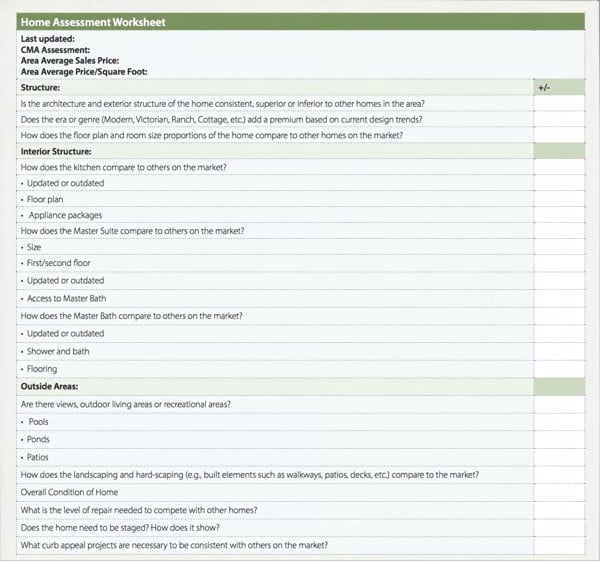
By answering a few questions about your home, property and the local market, you can begin to estimate your property’s value. We’ve also included a worksheet for you below…
How do the landscaping and hardscaping compare to the market? (e.g., built elements such as walkways, patios, decks, etc.)
If you want to accurately assess a home’s value, it’s crucial to know about the market activity of our local area. Sonja can help! Give her a call to get the scoop on the local market or email her.
Investopedia http://www.investopedia.com/terms/a/assessedvalue.asp
New York State Department of Taxation and Finance https://www.tax.ny.gov/pubs_and_bulls/orpts/mv_estimates.htm
Realtor.com http://www.realtor.com/advice/sell/assessed-value-vs-market-value-difference/
Investopedia, http://www.investopedia.com/articles/mortgages-real-estate/08/housing-appreciation.asp?lgl=myfinance-layout

Buyer
Buyer
Buyer



Lifestyle
Before you run out and pick up a flock of your own, there are a few important real estate rules.

Buyers
For the past two years, a lot of people have been waiting on the housing market to do.

Buyers
Every year, on the third Saturday in July, there is apparently a holiday called National Toss Away.

Buyer
If your agent is out of town, your first call probably shouldn’t be to another random agent.
You’ve got questions and we can’t wait to answer them.